
Auto-Screener vs selling soil: is it worth it?
When I would leave the Auto-Screener on, when I would sell the soil, and how charge costs, porters and Archaeology level change the answer.
Should you leave it on?
I like being able to leave Archaeology alone for longer, but I don't want to pay more for that convenience than I realise. The Auto-Screener can make excavation easier and give you useful materials. At some hotspots, though, the soil you feed into it is worth more than what you get back.
Check the soil price, the materials at your hotspot and your Archaeology level before deciding. If you're on an Ironman, start with the materials you need for restoration and whether you want to spend time screening soil later.
What you need
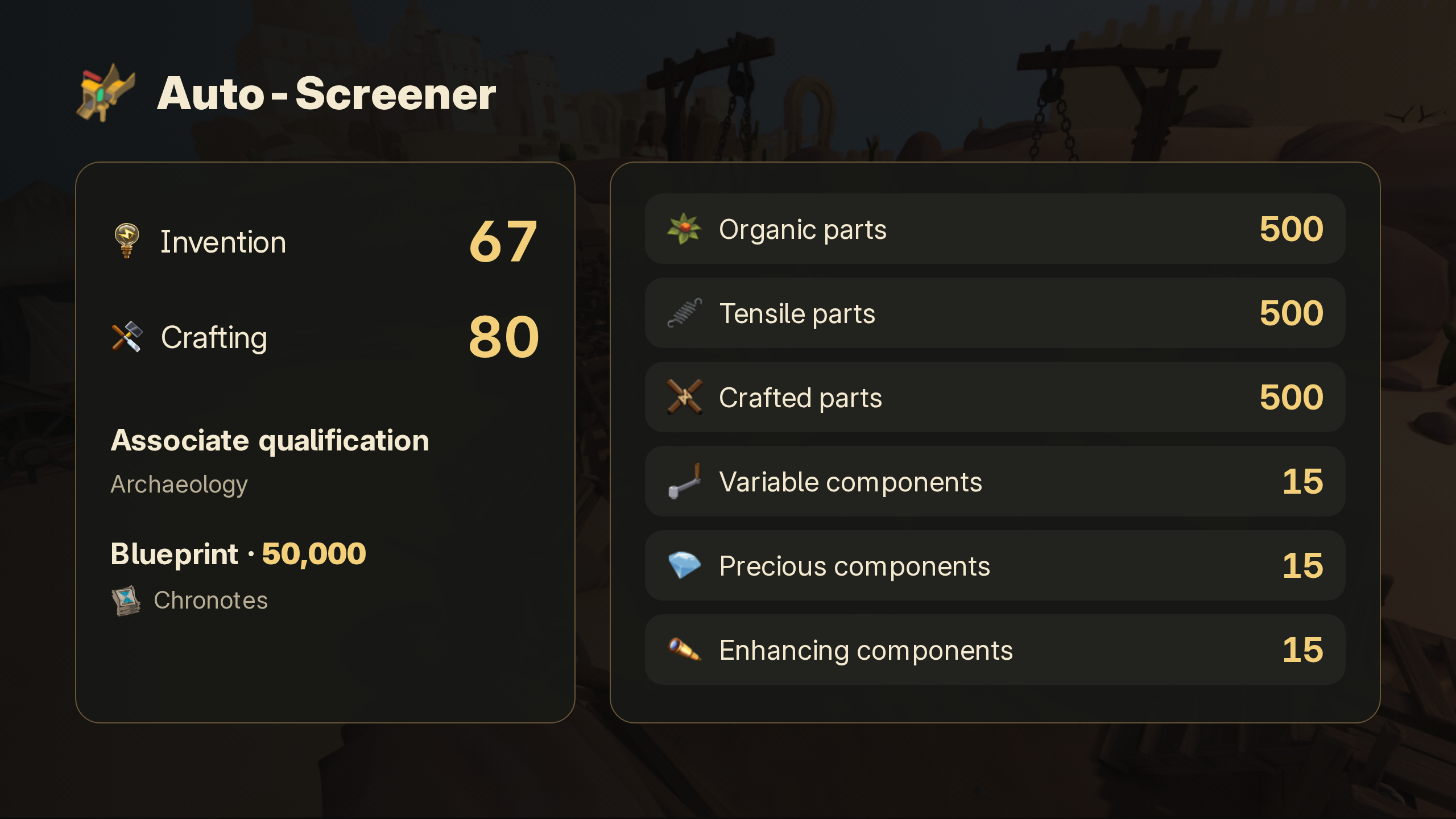
Making the Auto-Screener requires 67 Invention and 80 Crafting. You also need the Associate qualification to buy its blueprint for 50k chronotes, plus the components listed in the Auto-Screener recipe linked below.
Keep the device in your inventory while excavating and make sure your charge pack has energy. Divine charges refill the pack. Each soil-screening attempt uses energy, even when it fails to produce a material.
A successful attempt gives you a material from the hotspot you're excavating. Porters can send it straight to material storage. Without them, you'll need to deposit those materials yourself. That's the extra convenience you're paying for when you include porter charges.
How much does it cost to run?
One divine charge covers 900 soil-screening attempts. At about 72k GP per divine charge, that's about 80 GP each time the device processes soil.
A sign of the porter IV has 20 charges. At about 16k GP to make one, each material it transports costs about 800 GP. Failed screening attempts don't use a porter charge because there's nothing to transport.
Your porter tier matters. Compare the cost to make a sign with the number of charges it gives you, rather than looking only at the price of the whole sign. If you deposit materials yourself, leave porter costs out of the comparison.
Work out whether the soil is worth more
Start with the materials your hotspot can produce. Work out their average value using how often each material is received; a valuable material that appears less often shouldn't count as much as a common one.
Subtract your cost per porter transport from that average. Multiply the result by your screening success chance, then subtract the device's energy cost per soil. That gives you the average screened return to compare with selling one piece of soil.
Screened return per soil = success chance × (average material value − porter cost) − device energy cost.
Your Archaeology level makes a large difference. Without the master archaeologist's outfit, the success chance is about 55% at level 99 and 89% at level 120. The outfit improves it further. A failed attempt consumes the soil and device energy without giving you a material, so don't value every piece of soil as a guaranteed successful screen.
Lodge bar storage: selling can win
The examples here use September 9, 2026 prices, porter IV and no master archaeologist's outfit.
At Lodge bar storage, fiery brimstone was worth about 2k GP each. The hotspot's materials averaged about 2.7k GP before costs. After allowing for failed attempts, device energy and porter charges, screening returned about 960 GP per soil at level 99, or about 1.6k GP at level 120.
I'd sell the soil at those prices if I wanted the most GP from it. Leaving the device on at level 120 means giving up roughly 400 GP per soil for the convenience.
Depositing materials yourself changes the result. At level 120, the screened return rises to about 2.3k GP per soil without porter costs. That's ahead of selling, but you'll be making the deposit trips yourself. If you're trying to play while doing something else, decide whether that extra attention is worth it to you.
Administratum debris: a better place to screen
At Administratum debris, ancient gravel was only about 300 GP each. The materials were worth enough that screening at level 120 returned about 3.2k GP per soil after device energy and porter IV charges.
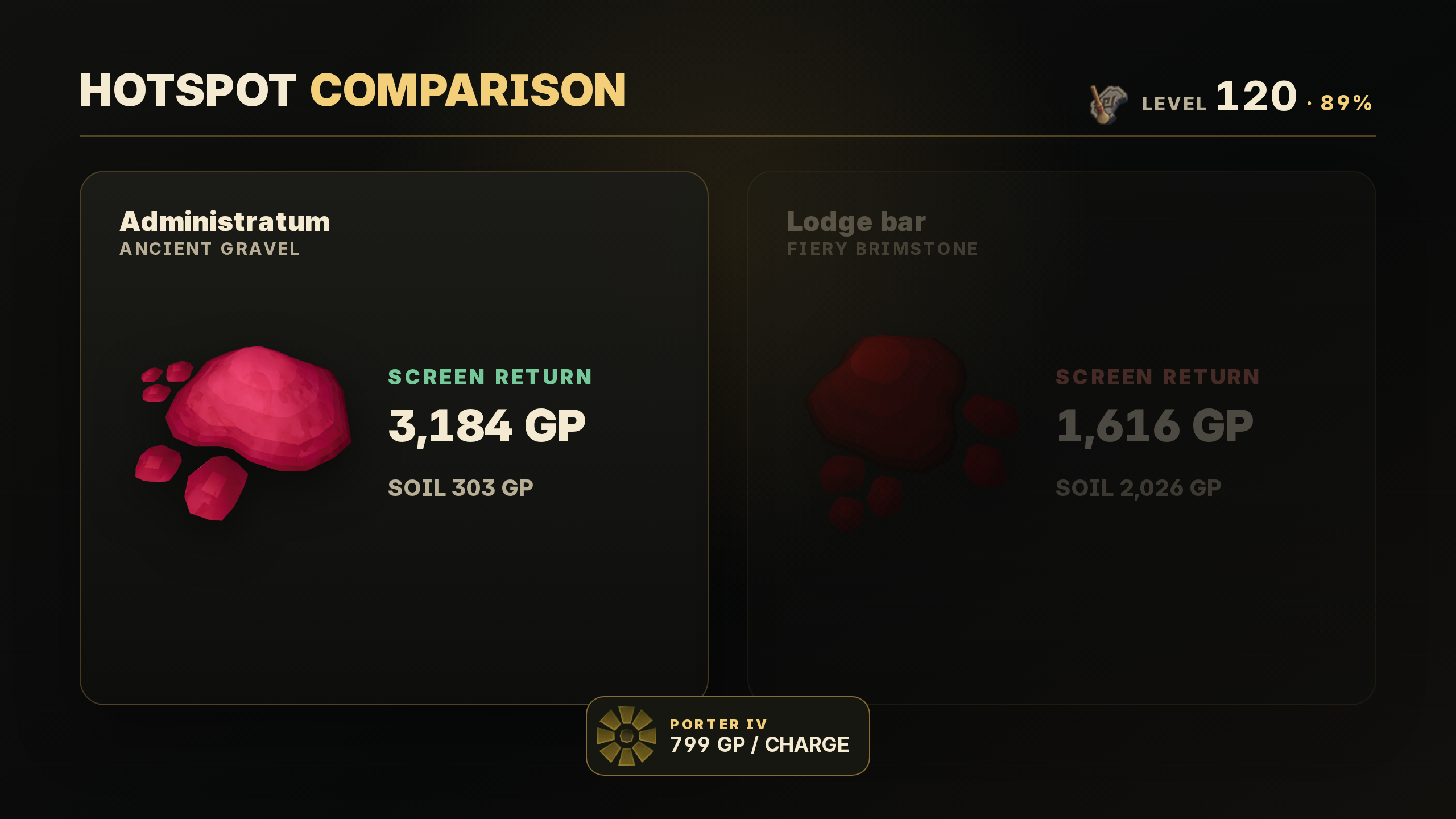
Here I'd leave the Auto-Screener on. You get the easier excavation setup and a much higher material return than the soil's sale value. Check again when you move hotspots: the material pool can change the answer even when your level and equipment stay the same.
What I'd consider on an Ironman
If you're short on restoration materials, the Auto-Screener supplies extra materials from your current hotspot without another screening session later. That can be useful when you're already excavating the artefacts you need.
Saving soil gives you another option. You can screen it after gaining more Archaeology levels, when the success chance is higher. Screening at a station also has a wider eligible material pool and can give Archaeology XP and damaged artefacts. The Auto-Screener gives neither screening XP nor damaged artefacts.
Look at what you're missing before choosing. Extra hotspot materials now may help you finish restorations sooner; saved soil may be more useful once you're a higher level and have time to screen it.
Should you use Flow State instead?
Flow State is an Archaeology relic power that increases excavation precision and stops you receiving soil. With no soil coming in, the Auto-Screener has nothing to process.
You still receive the ordinary materials from excavation. You lose the additional materials you could have received by screening the soil, whether automatically or later at a station.
If you want faster artefact discoveries and can cover the restoration materials, consider Flow State. If materials are already holding you up, check that shortage before giving up the soil. For an AFK setup, I'd choose the hotspot first, compare its soil and material values, then decide how much I'm willing to spend on fewer interruptions.